





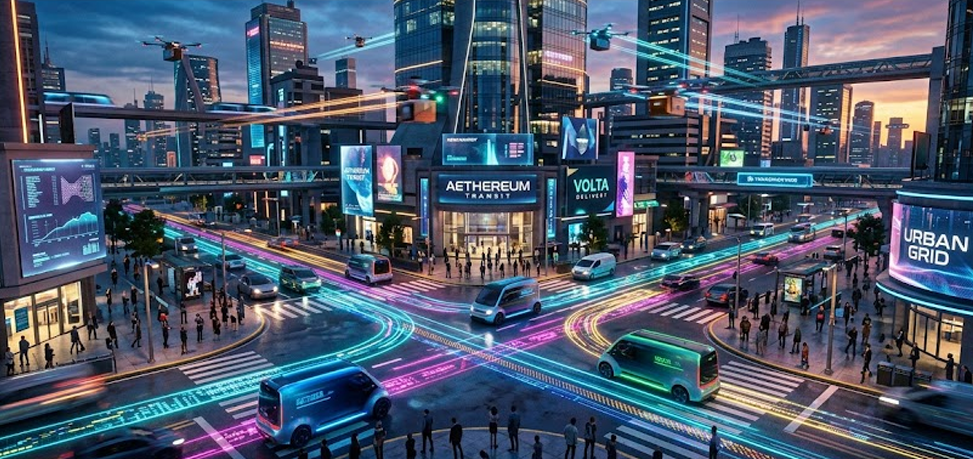
The modern metropolis is facing an impending gridlock. As e-commerce demands skyrocket and urban populations density hits historic highs, traditional logistics systems are buckling under the weight. The solution being deployed across global hubs isn’t more asphalt—it is the implementation of decentralized, AI-driven autonomous logistical networks.
By turning city streets into data-driven ecosystems, artificial intelligence is quietly restructuring how goods move through our urban spaces, creating the foundation for truly autonomous smart cities.
Last-Mile Delivery and the Drone Grid
The most expensive, inefficient, and carbon-heavy portion of any shipping journey is the final stretch: the “last mile.” Traditional delivery trucks idling in traffic, hunting for rare parking spaces, and double-parking on narrow city blocks account for a massive chunk of urban congestion.
Smart cities are solving this by shifting the last mile off the asphalt and into the air.
- Micro-Fulfillment Hubs: Automated urban warehouses act as miniature staging grounds where regional cargo is broken down into localized deliveries.
- Autonomous Air Corridors: AI traffic controllers manage a highly coordinated, multi-layered mesh network of delivery drones, ensuring they navigate safely around buildings, utility lines, and human crowds.
- Precision Dropzones: Drones drop payloads directly onto designated smart lockers or secure building roofs, removing heavy delivery vans from residential neighborhoods completely.
Predictive Traffic Management and Dynamic Routing
Autonomous delivery vans and sidewalk rovers don’t just react to traffic; they anticipate it. Unlike a human driver relying on a standard GPS, city-wide logistics AIs are plugged directly into the municipal infrastructure’s neural network.
Autonomous delivery vans and sidewalk rovers don’t just react to traffic; they anticipate it. Unlike a human driver relying on a standard GPS, city-wide logistics AIs are plugged directly into the municipal infrastructure’s neural network.
[Static Route]   -> Human Driver -> Trapped by Sudden Accident -> Gridlock Delay
[Dynamic Route]  -> AI Fleet     -> Detects Micro-Delays Early -> Pre-emptively Reroutes Fleet
By ingesting real-time data from street cameras, stoplight sensors, construction schedules, and even sudden weather changes, the central logistics brain dynamically recalculates thousands of fleet routes every single second.
If a major intersection experiences a minor delay, the AI instantly splits up its automated fleet, distributing vehicles across optimized side streets to prevent a localized traffic bottleneck before it even starts.
Automated Loading Zones and Curb-Space Optimization
In a traditional city, curb space is a chaotic free-for-all. Delivery drivers, rideshare vehicles, and private cars constantly battle for space, grinding traffic flow to a halt. In an AI-optimized smart city, the curb becomes a dynamic, programmable resource.
Using computer vision and smart-pavement sensors, the city’s central management system can dynamically rezone parking spaces on the fly.
When an autonomous delivery van approaches its destination, the smart city automatically reserves an open loading zone exactly when the vehicle arrives. The moment the van unloads its cargo and departs, the curb instantly reverts back to a public parking spot or a rideshare pickup zone, maximizing utility and keeping transit lanes clear.
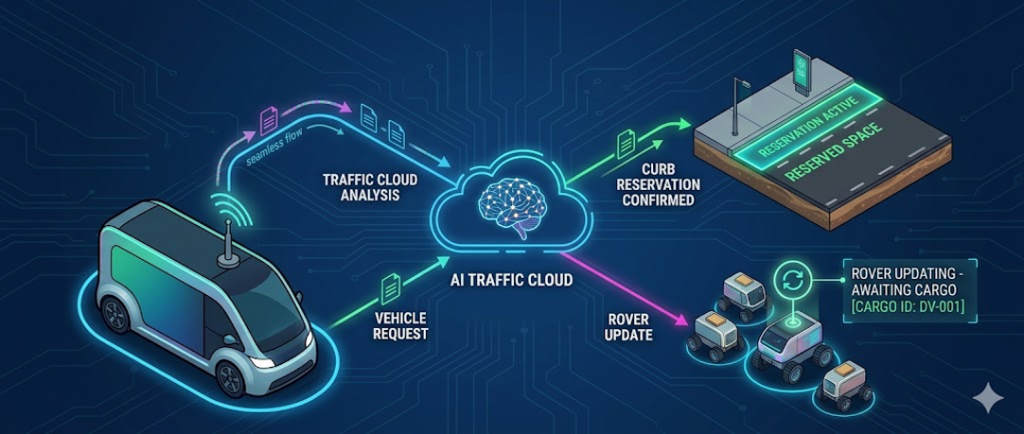
The image is created by AI.

Leave a comment