





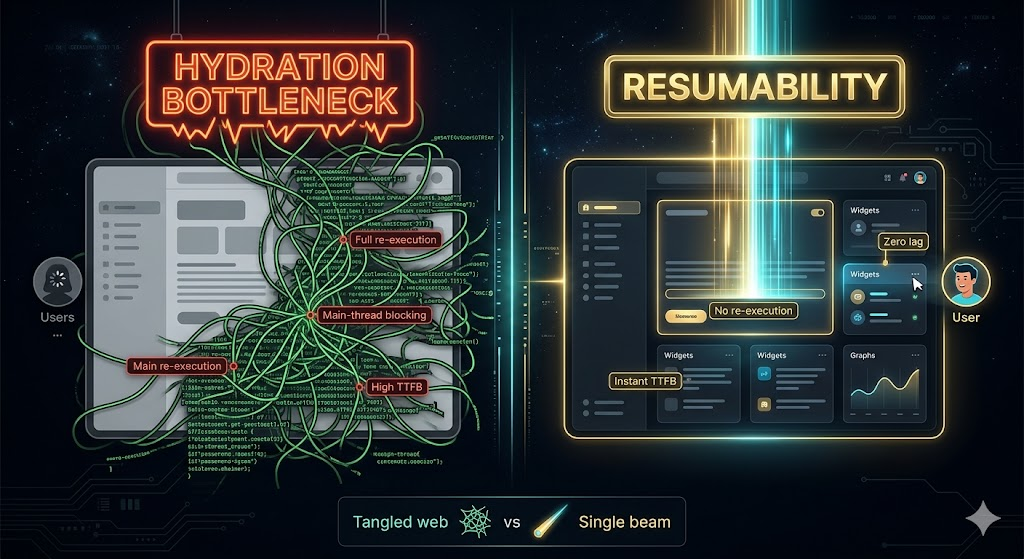
For years, the standard recipe for building an incredibly fast, highly interactive web application followed a predictable formula: Server-Side Rendering (SSR). Frameworks like Next.js, Nuxt, and Remix would generate the page’s HTML structure on a cloud server, instantly ship that lightweight document to the browser, and give the user a fast initial visual load.
But this architecture harbors a hidden performance tax. While the user can see the website immediately, they often cannot interact with it right away. Clicking a mobile menu button or trying to scroll an image carousel results in dead air because the browser is frozen in the background trying to download, parse, and execute a massive block of JavaScript. This phase is known as Hydration—and it has become the single biggest performance bottleneck on the modern web.
The Problem: How Traditional Hydration Freezes the Browser
To understand why hydration is a problem, you have to look at what happens inside the browser engine immediately after a server-rendered web page lands on a device.
The HTML document sent by the server is essentially a dead visual shell. To make the page interactive, the browser must perform a tedious, computationally heavy process:
[Server HTML Arrives] -> Browser Downloads Entire JS Bundle -> Re-Parses Code -> Re-Executes Components -> Hooks Up Event Listeners -> [Page Finally Interactive]This means the browser effectively re-executes the entire application a second time, rebuilding the component tree from scratch just to figure out which click event listeners attach to which HTML elements. On lower-end mobile devices or weak data connections, this heavy hydration loop can completely block the browser’s main thread for several seconds, leading to a massive spike in your Interaction to Next Paint (INP) metric.
The Solution: Enter Resumability
To end this computational duplication, next-generation web frameworks like Qwik have introduced a revolutionary alternative rendering paradigm: Resumability.
Resumability is built on a simple, brilliant premise: Why should the browser have to recreate work that the cloud server has already finished?
Instead of forcing the browser to download and execute a massive bundle of JavaScript just to find out where the event listeners live, a resumable framework serializes that exact information directly into the HTML document at the server level.
How Resumability Changes the Frontend Game:
- Zero Initial JavaScript: Resumable web pages load with a baseline of 0kb of initial JavaScript. The page is fully interactive almost instantly upon arrival.
- Serialized Event Listeners: The HTML shipped to the browser contains explicit, miniature text markers indicating exactly what code to execute on a click (e.g.,
on:click="chunk_abc.js"), bypassing the parsing phase entirely. - On-Demand Execution: The browser does not download or parse a component’s JavaScript code until a user explicitly clicks on that specific component.
The Strategic Framework Showdown
The battle line in modern frontend architecture is officially drawn between frameworks that rely on progressive hydration and those championing pure resumability or zero-JavaScript architectures.
The Architectural Matrix
| Framework Strategy | How It Handles JavaScript | Best Used For |
| Monolithic Hydration (Traditional Next.js / Remix) | Downloads and executes the entire application framework script before the page becomes interactive. | Rich, authenticated SaaS dashboards where users stay logged in for hours. |
| Island Architecture (Astro) | Renders a completely static HTML page but isolates highly interactive dynamic widgets into isolated, self-hydrating “islands.” | Content-heavy publishing platforms, blogs, portfolios, and marketing landing pages. |
| Resumability (Qwik) | Freezes the application execution state on the server and instantly resumes it in the browser with zero execution overhead. | High-traffic e-commerce storefronts where every millisecond of interaction delay directly hurts conversions. |
The image is created by AI.

Leave a comment