





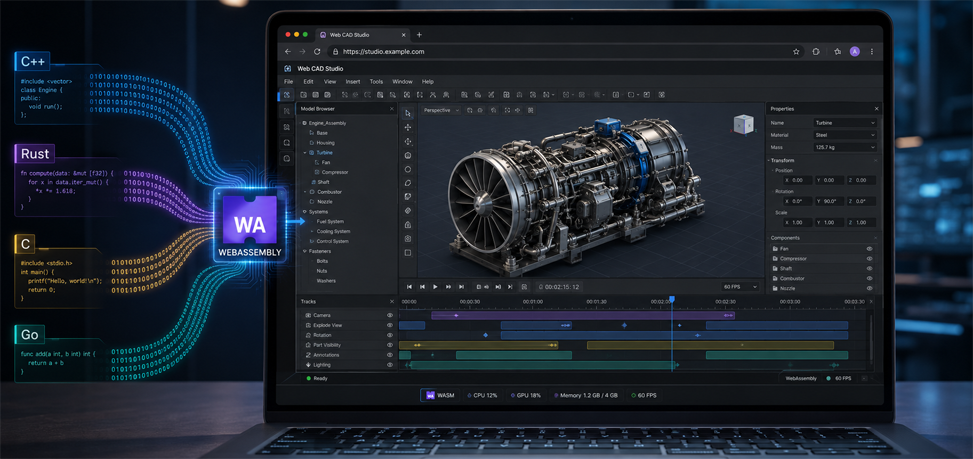
For decades, the division between web applications and native desktop software was crystal clear. If you wanted to check social media or read an article, you opened a browser. But if you needed to edit a 4K video, compile massive codebases, or render complex 3D models, you had to download and install heavy, native executable software directly onto your operating system.
That division is completely dissolving. Thanks to WebAssembly (WASM), the web browser is evolving into a high-performance operating system capable of running desktop-class software at near-native speeds.
What is WebAssembly and Why Does JavaScript Need It?
To understand why WebAssembly is a game-changer, we have to look at the historical limitation of web browsers: they could only natively understand JavaScript.
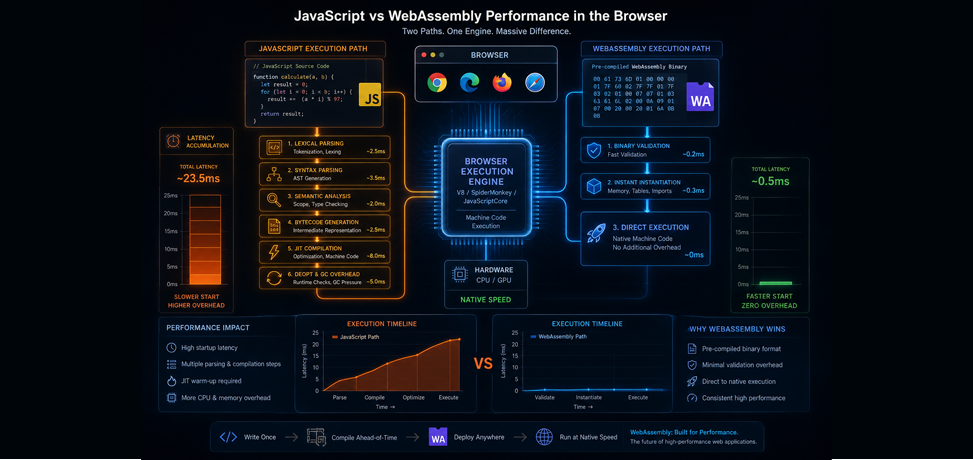
While JavaScript is an incredible language for making web pages interactive, handling animations, and managing form inputs, it was never designed for heavy computational math. JavaScript is an interpreted, dynamically typed language, meaning the browser has to read, compile, and execute it on the fly while the user is actively interacting with the page. This creates a massive performance bottleneck when handling millions of data points per second.
[Traditional Web] -> C++ / Rust Source -> (Can't Run in Browser) -> Must Rewrite in JavaScript (Slow)
[Modern WASM Web]  -> C++ / Rust Source -> Compiled to .wasm Binary -> Executed by Browser Engine (Near-Native Speed)
WebAssembly completely sidesteps this limitation by acting as a low-level, binary code format that browsers can execute with near-native performance.
- Bring Your Own Language: Developers don’t write WebAssembly from scratch. Instead, they write high-performance code in languages like C++, Rust, or Go, and compile that code into a compact
.wasmbinary file. - Direct Hardware Access: The web browser reads this pre-compiled binary file and executes it directly through the computer’s CPU at lightning speed, entirely bypassing the heavy compilation overhead that slows down traditional JavaScript.
Turning Browsers into Production Studios
WebAssembly isn’t a futuristic concept—it is already driving the web tools you likely use every day. Tech giants have realized that moving desktop software into the browser removes friction, eliminates painful installation guides, and makes collaboration as simple as sharing a web link.
Real-World Production Software Running on WASM:
- Figma’s Graphic Engine: Figma’s incredibly smooth design canvas is powered by a C++ engine compiled down into WebAssembly, allowing thousands of vector paths to render instantly in real time.
- Adobe Photoshop Web: Adobe successfully brought its legendary, decades-old desktop photo editor entirely to the web browser by compiling its massive C++ codebase directly into WebAssembly.
- In-Browser Video Editing & Gaming: Modern browser-based video editors can decode, cut, and preview 4K video footage entirely within a tab, while game engines can render intensive 3D environments without requiring a standalone game installation file.
JavaScript and WASM: Partners, Not Rivals
A common misconception in the development community is that WebAssembly is here to kill off JavaScript. In reality, they are designed to be the ultimate tag team.
In a modern desktop-class web application, JavaScript acts as the conductor and user interface manager, handling user clicks, managing the DOM, and styling layout elements. Meanwhile, WebAssembly acts as the heavy-lifter, sitting quietly in the background waiting for intensive computational tasks—like processing an image filter, calculating 3D physics, or encrypting data streams.
By offloading the heavy math to WASM and leaving the user experience to JavaScript, web applications achieve a level of fluid, uncompromised speed that makes web apps completely indistinguishable from installed desktop software.
The image is created by AI.


Leave a comment