






For years, the standard approach to building a large-scale web application followed a predictable pattern: a single, massive frontend code repository—a monolith. Every feature, from user authentication to checkout flows and product reviews, was bundled into one giant codebase.
While this works beautifully for small teams, it becomes a logistical nightmare as an organization grows. A tiny bug in the review panel can bring down the entire checkout page, and multiple engineering squads constantly step on each other’s toes trying to deploy updates. Enter Micro-Frontends—an architectural shift that breaks down monolithic websites into agile, independently deployable web components.
What Exactly is a Micro-Frontend Architecture?
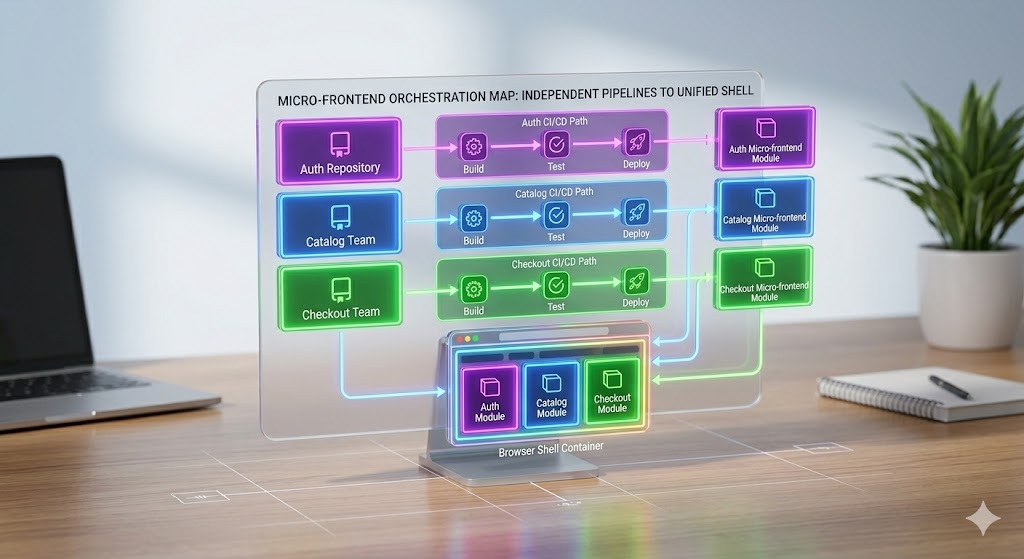
The core philosophy of micro-frontends is identical to the microservices model used on the backend. Instead of building one giant website, you divide the user interface into distinct, self-contained functional slices.
Each slice is completely autonomous. It owns its own data fetching logic, its own state management, and is developed and deployed by an isolated, specialized team.
[Monolithic Web]  -> [ All Features & Frameworks Bundled Together ] -> Single Points of Failure
[Micro-Frontend] -> [ Auth Team App ] + [ Checkout Team App ] + [ Search Team App ] -> Unified User Shell
When a user visits the platform, a lightweight wrapper program called the Container Shell mounts these independent micro-apps into place on the screen. To the end user, the website feels like a single, completely unified application, but under the hood, it is a highly coordinated ecosystem of miniature websites working together.
The Core Advantages of Going Modular
Shifting away from a monolith requires an initial investment in pipeline setup, but for mid-to-large-scale companies, the return on engineering efficiency is massive.
- Independent Deployment Cycles: The payment team can push a critical hotfix to production at 2:00 PM without needing to consult the marketing team or rebuild the entire application stack.
- Technology Agnostic Slices: Because micro-frontends run in isolation, different teams can use completely different tech stacks if a feature demands it. The search bar could be built using lightweight Svelte for maximum speed, while a complex data dashboard runs on React.
- Blast Radius Isolation: If a third-party API dependency crashes the product review widget, that specific component can fail gracefully or show an error state while the rest of the application remains perfectly interactive.
The Technical Core: Module Federation
Historically, trying to stitch different frontend apps together resulted in massive performance penalties because the browser was forced to download duplicate framework files (like loading React three separate times).
The breakthrough that made micro-frontends commercially viable is Module Federation (introduced natively in modern build tools like Webpack and Vite). Module Federation allows separate web applications to dynamically share code and runtime dependencies at runtime.
How Module Federation Optimizes the Web:
- Shared Dependencies: If the Container Shell detects that the browser has already downloaded React, it instructs incoming micro-frontends to skip downloading it again, keeping initial bundle sizes small and load times fast.
- On-Demand Loading: Micro-frontends are only downloaded into the user’s browser when they are actually needed. The checkout application code stays completely untouched until the user clicks the “Proceed to Cart” button.
The image is creadted by AI.


Leave a comment