






For nearly three decades, the third-party cookie was the undisputed backbone of the commercial web. It tracked users across different websites, mapped out their browsing habits, and allowed advertisers to serve highly targeted ads. If you looked at a pair of shoes on an e-commerce site, third-party cookies ensured those exact shoes followed you around the web for the next two weeks.
But that era has officially ended. Driven by sweeping data regulations (like GDPR and CCPA) and aggressive privacy changes from major browsers, the third-party cookie is dead. Web developers and digital marketers are completely rewriting how identity, tracking, and monetization function across the internet.
The Difference Between First-Party and Third-Party Cookies
To navigate this privacy-first shift, it’s critical to understand exactly what has changed. Not all cookies are banned. The industry has drawn a sharp line between first-party and third-party data architecture:
[User visits ShopA.com] -> Sets Cookie from ShopA.com (First-Party) -> Allowed & Essential
[User visits ShopA.com] -> Sets Cookie from TrackerX.com (Third-Party) -> Blocked by Browser- First-Party Cookies (Safe & Essential): These are created and stored directly by the website the user is actively visiting. They handle critical tasks like keeping a user logged in, remembering items in a shopping cart, and saving language preferences. These remain perfectly intact.
- Third-Party Cookies (Blocked): These are generated by external tracking domains embedded within a website via scripts or invisible pixels. Because they track user movements across completely unrelated domains to build a invasive behavioral profile, modern browsers now block them by default.
The New Standard: Privacy-First Privacy Sandbox APIs
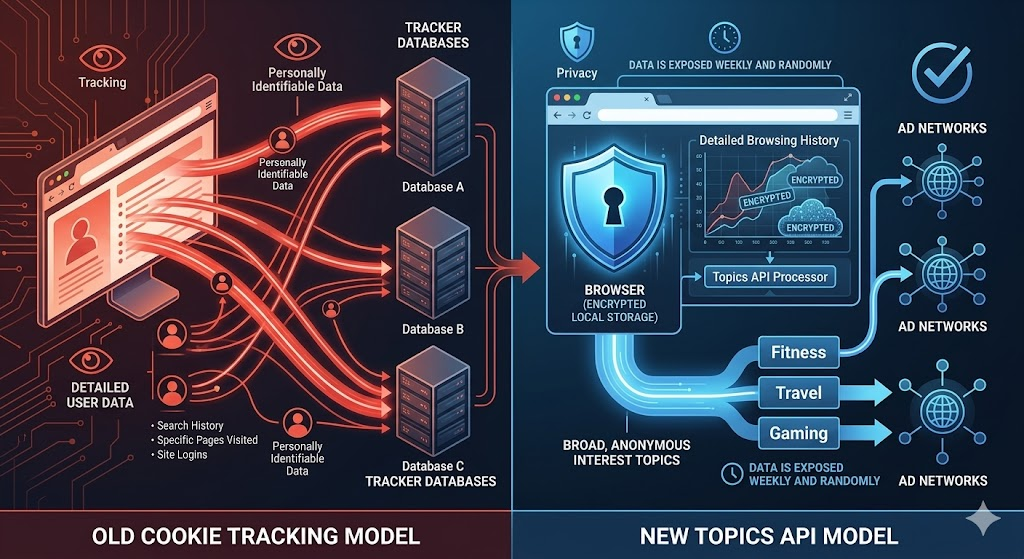
To prevent the total collapse of the web’s economic model while respecting user privacy, browser engines have introduced alternative tracking architectures. The most notable framework is Google’s Privacy Sandbox, which shifts the heavy lifting of user profiling away from external corporate servers and directly onto the user’s local device.
Key Alternatives Replacing Third-Party Cookies:
- The Topics API: Instead of tracking exactly which URLs a user visits, the browser locally observes browsing habits and assigns the user a few broad, anonymous interest categories each week (e.g., “Fitness” or “Travel”). When an ad requests a placement, the browser shares these high-level topics without ever exposing the user’s specific identity or browsing history.
- Protected Audience API: This handles remarketing without tracking. Custom ad auctions are executed locally on the user’s device rather than streaming user profiles back to massive ad-tech databases.
- Attribution Reporting API: This allows marketers to measure whether an ad click led to a purchase or sign-up without tracking the exact, individualized user journey across multiple platforms.
The Rise of Zero-Party Data and Server-Side Tagging
With third-party tracking algorithms out of commission, the focus has shifted entirely to building direct relationships with web users. This has triggered a massive rise in Zero-Party Data—information that a customer intentionally and proactively shares with a brand.
Modern websites are deploying interactive quizzes, customized account onboarding flows, and conversational preference centers. Instead of guessing what a user wants via invisible tracking pixels, sites are simply asking them directly.
Furthermore, web developers are abandoning traditional client-side browser tracking in favor of Server-Side Tagging. Instead of loading dozens of bloated third-party JavaScript tracking files in the visitor’s browser (which slows down performance and triggers ad-blockers), the website sends data to its own secure cloud server first. The server cleans, anonymizes, and filters the data before forwarding only the necessary, compliance-safe data packets to analytic endpoints.


Leave a comment