





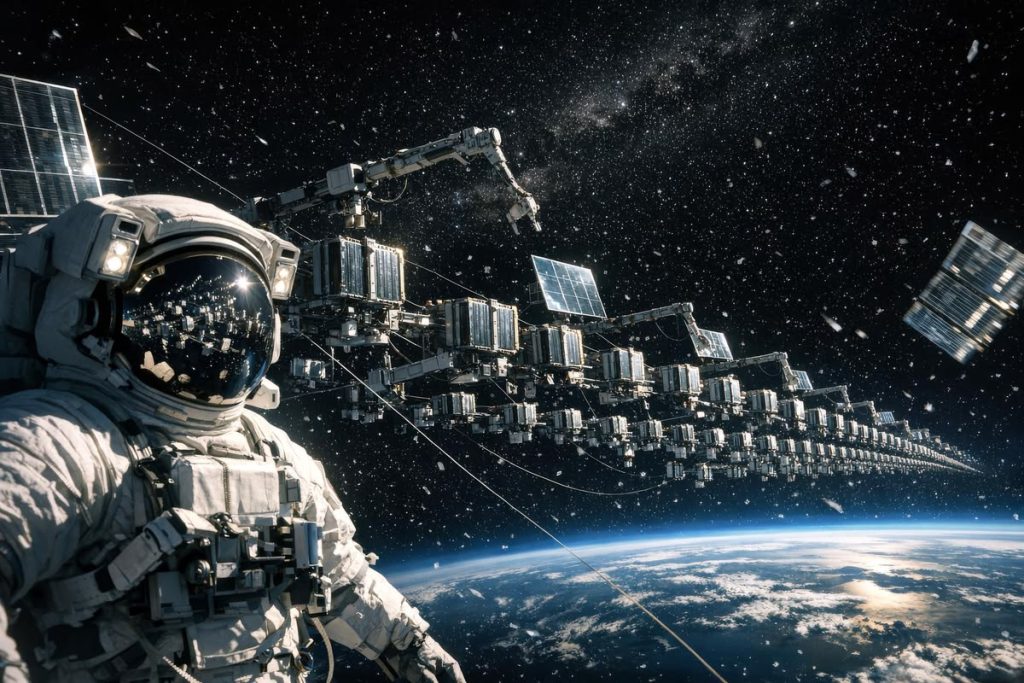
As artificial intelligence models grow exponentially larger, the terrestrial digital infrastructure supporting them is hitting a wall. On Earth, building an AI data center requires navigating complex land rights, straining municipal power grids, and consuming millions of gallons of water for cooling.
To bypass these earthly limitations, space tech startups and global technology giants are looking upward. The next frontier for heavy computational processing isn’t in a warehouse in Virginia or Dublin—it is in Low Earth Orbit (LEO).
The Infinite Heat Sink
The biggest operational expense for an earthbound data center is cooling down thousands of blazing-hot computer chips. Space solves this problem natively. The vacuum of space offers an environment where data centers can radiate excess heat directly into the cosmic void. By positioning servers correctly, tech companies can take advantage of the ultra-cold conditions of orbit, cutting cooling costs to zero and allowing processing chips to run at maximum speeds without overheating.
The Ultimate Heat Sink: The Cold Vacuum of Space
On Earth, thermodynamics is a constant battle. As thousands of processing chips run complex neural networks, they generate intense heat that must be actively managed. In contrast, deep space provides a unique environmental advantage.
The ambient temperature of space is incredibly cold, sitting just above absolute zero. While vacuum conditions mean there is no air to carry heat away via traditional fans, satellites can utilize specialized highly efficient thermal radiators.
[Earth Data Center] -> Uses Water/Fans -> Fights Atmosphere -> High Cooling Overhead
[Orbital Data Center] -> Uses Radiators -> Dumps Heat to Space -> Zero Fluid Waste
By mounting high-density processing units onto orbital platforms, data centers can bleed off excess operational heat directly into the cosmic vacuum. This eliminates the need for complex fluid-chilling infrastructure or massive water loops, achieving a level of cooling efficiency that is physically impossible on the Earth’s surface.
Capitalizing on Declining Launch Costs
A decade ago, the concept of launching heavy, power-hungry server racks into orbit would have been laughed out of any corporate boardroom. The cost per kilogram to send payloads into space was simply too restrictive.
However, the rapid commercialization of the aerospace industry has changed the economic equation entirely.
- Reusable Rocketry: The rise of commercially viable, fully reusable heavy-lift rocket platforms has driven the baseline cost of launching payloads to historic lows.
- Miniaturized Hardware: The development of radiation-hardened, high-density edge-computing blades allows companies to pack massive processing power into compact, lightweight satellite frames.
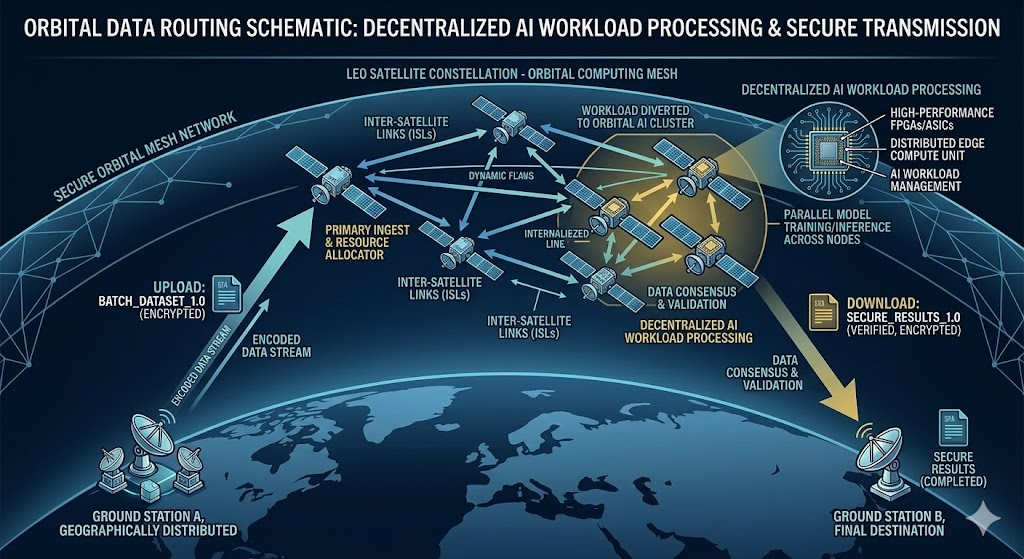
- Constellation Networks: Deploying modular, interconnected mesh networks of smaller satellites allows companies to scale up their orbital processing power incrementally, rather than relying on a single, massive launch.
Solar Abundance and Uninterrupted Power
Beyond cooling, the second greatest bottleneck for terrestrial AI is power generation. Earthbound facilities are limited by regional grid capacities, weather variations affecting solar arrays, and the inevitable drop in solar production during the night.
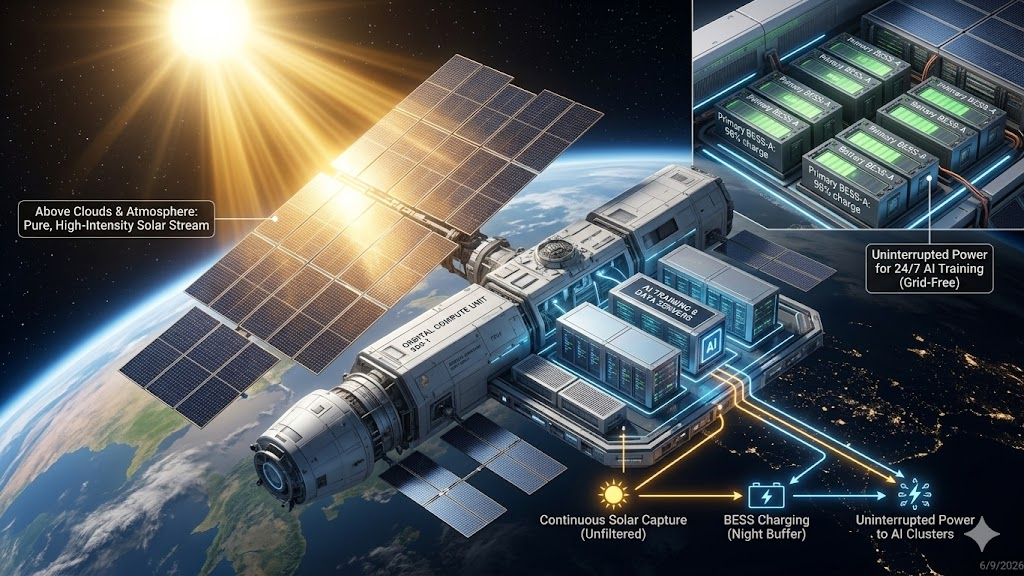
An orbital data center in a sun-synchronous orbit experiences none of these limitations.
Positioned above the atmosphere and clouds, space-bound solar panels capture completely unfiltered, high-intensity sunlight. Because the satellites can be oriented to face the sun almost continuously, they receive an uninterrupted stream of pure, clean solar energy. This allows orbital servers to train massive AI models around the clock without drawing a single watt from civilian power grids or relying on fossil-fuel backup generators.
The Image was created by an AI.

Leave a comment