





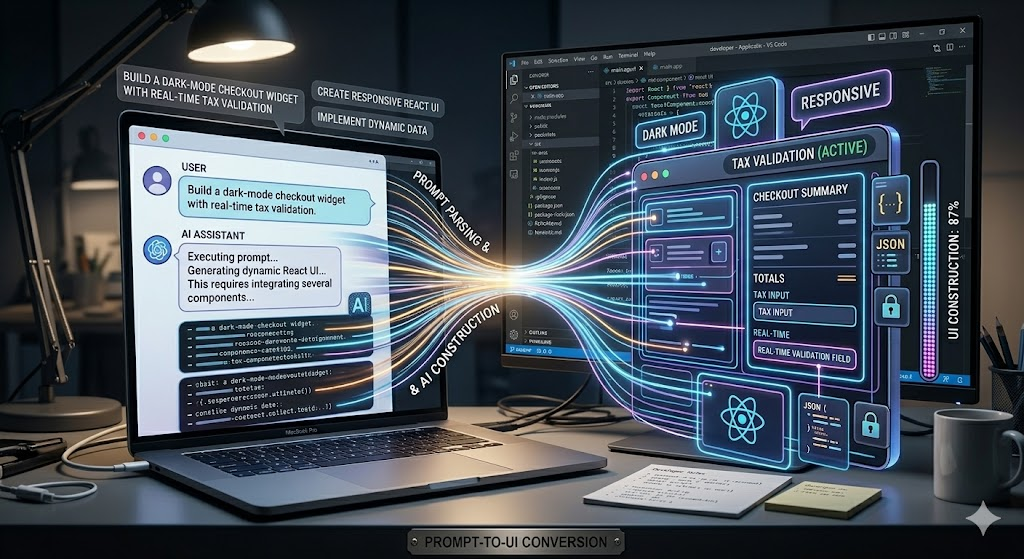
For as long as the internet has existed, building a functional website frontend required mastering an intricate web of languages and tools. If you couldn’t write HTML structure, style with CSS, orchestrate state with JavaScript, and navigate complex build tools, your ideas remained trapped in your head.
But a fundamental paradigm shift has arrived. The phrase “Vibe Coding”—originally coined by AI pioneer Andrej Karpathy—has evolved from an engineering meme into a mainstream development methodology. By leveraging advanced generative AI pipelines, natural language is becoming the ultimate frontend programming language, changing who can build for the web and how fast.
What Exactly is Vibe Coding?
Vibe coding shifts the developer’s or creator’s role from imperative programming (meticulously writing code line-by-line) to declarative orchestration (describing the intended outcome and managing the flow).
Instead of getting bogged down by missing semicolons, complex UI layout logic, or brittle framework setups, a builder simply explains the “vibe” and functional requirements of a web component in plain English. The AI interpreter handles the heavy execution.
[Traditional Dev] -> Logic Plan -> Write Boilerplate -> Debug Syntax -> Manual Layout -> Done
[Vibe Coding]    -> English Prompt -> AI Generates UI Stack -> Review & Refine -> One-Click Deploy
The magic relies on an iterative, conversational loop:
- Intent Capture: The user outlines a functional requirement (e.g., “Add a responsive filtering sidebar for an e-commerce grid that updates instantly without page reload”).
- Instant Visual Execution: Browser-native AI tools interpret the prompt, write production-ready code, compile the code in the background, and render a live, clickable preview within seconds.
- Refinement by Feel: If a layout element feels misaligned or an animation feels too sluggish, the user simply replies, “Make the slide-in transition smoother and shift the text 5 pixels to the left.” The AI modifies the underlying code instantly.
From Demos to Production: The Tool Ecosystem
Vibe coding is no longer confined to generating isolated code snippets that you have to manually copy and paste into an IDE. The modern ecosystem consists of autonomous, full-stack environments running natively in the browser.
The Defining Frontend AI Tools:
- Vercel v0: A powerhouse for frontend engineering. It takes natural language prompts and instantly outputs beautiful, production-ready React components styled with Tailwind CSS, closing the gap between raw prototype and deployed frontend.
- Lovable & Bolt.new: Browser-native development platforms that generate entire application frontends from single text descriptions, automatically setting up underlying framework architectures behind the scenes.
- Cursor & Windsurf IDEs: Advanced code environments that utilize autonomous multi-agent systems to read entire local project directories, allowing developers to refactor complex frontend structures via a side-panel chat window.
There’s a new kind of coding I call ‘vibe coding’, where you fully give in to the vibes, embrace exponentials, and forget that the code even exists. It’s possible because the LLMs are getting too good.
Andrej Karpathy
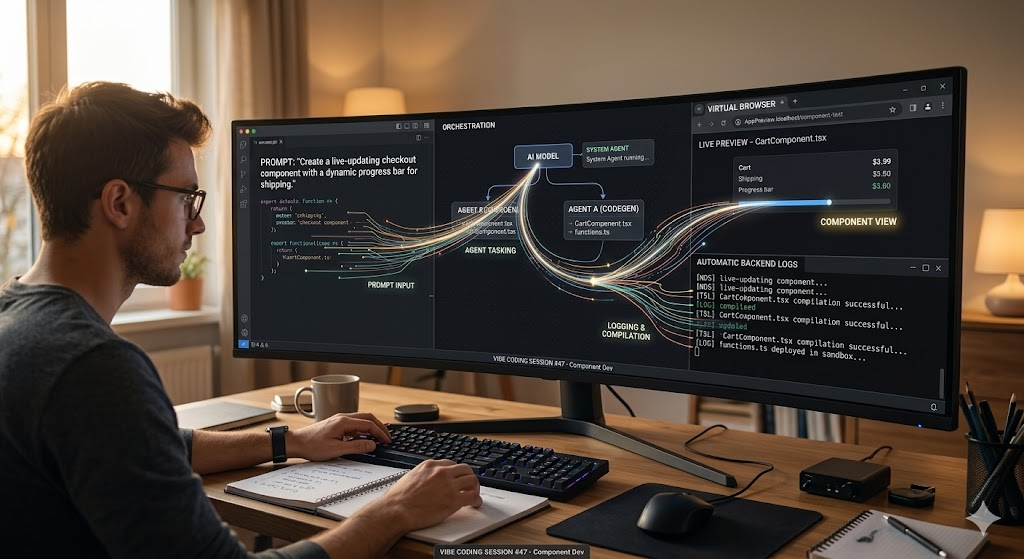
The “Day 2” Problem: Why Engineering Principles Still Matter
While vibe coding has democratized web creation and accelerated initial prototyping by up to 10x, it has also sparked intense debate within the software community. Critics point out that while generating code is incredibly easy, maintaining it introduces a brand-new set of challenges—often called the “Day 2” problem.
AI models, when left entirely unchecked, can occasionally produce “black box” code—spaghetti code structures that look flawless on the surface but are fragile, inefficient, or difficult to scale under heavy user loads.
Because of this, the most successful builders aren’t replacing engineering knowledge entirely. Instead, they are using their architectural skills to guide the AI. By understanding system behaviors, API boundaries, and security rules, human orchestrators ensure that the vibe-coded components generated by AI remain secure, accessible, and ready to scale for the real world.
The image is created by AI.


Leave a comment