






For millennia, the diversity of human language has been both a beautiful cultural treasure and a massive obstacle to global unity. Miscommunications have rewritten history, closed off business markets, and isolated travelers.
But we are living through the final days of the language barrier. Driven by breakthroughs in generative audio AI and neural machine translation, the sci-fi dream of a universal translator is officially a reality, fundamentally altering how humanity connects.
The Technology: Low-Latency Audio Pipelines
Real-time translation isn’t just about swapping words from a digital dictionary. Human speech is fast, nuanced, and deeply dependent on context, tone, and cultural idioms.
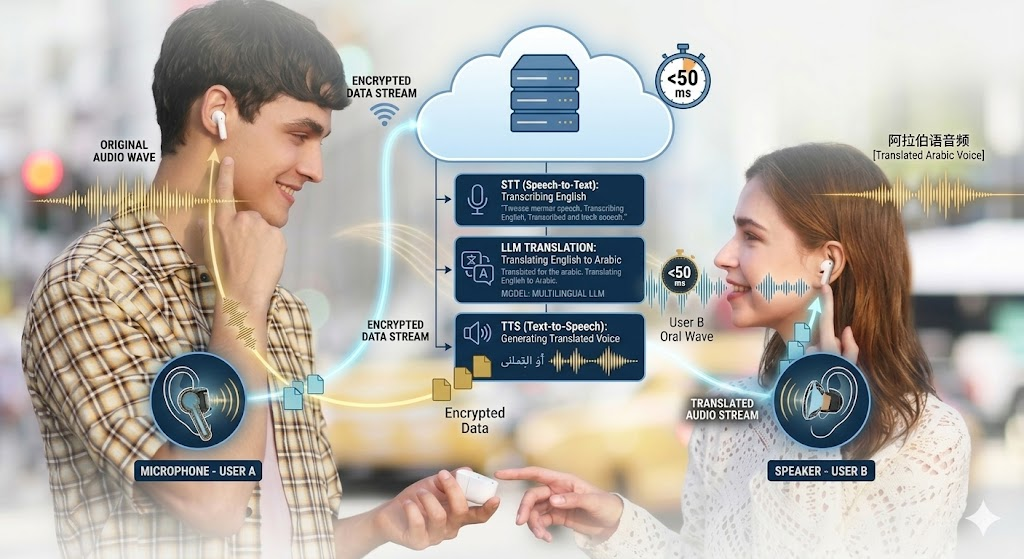
To translate a live conversation seamlessly without awkward, multisecond pauses, technology giants have engineered highly optimized, three-stage low-latency audio pipelines:
[Spoken Input] -> 1. Neural Speech-to-Text -> 2. Contextual AI Translation -> 3. Low-Latency Text-to-Speech -> [Translated Audio]- Neural Speech-to-Text (STT): Advanced acoustic models instantly isolate the speaker’s voice from ambient background noise, converting the spoken audio into digital text while capturing tone and cadence.
- Contextual Translation: Large language models (LLMs) analyze the text not just word-by-word, but at the sentence and paragraph level. This ensures the AI understands idioms, sarcasm, and specialized professional terminology before selecting the correct cross-cultural equivalent.
- Voice-Preserving Text-to-Speech (TTS): The translated text is instantly converted back into spoken audio. The breakthrough here is voice cloning: the AI speaks the new language while mimicking the original speaker’s actual vocal pitch, accent, and emotional inflection.
Changing the Fabric of Business and Tourism
This technology is moving out of bulky smartphone apps and into the hardware we already wear every day: wireless earbuds.
With advanced simultaneous translation embedded directly into consumer earbuds, international communication becomes completely frictionless. You can speak your native language at a normal conversational pace, and the person standing across from you hears it in their native tongue just a fraction of a second later.
Major Global Impacts:
- The Borderless Executive: Small-business owners can negotiate directly with international suppliers, manufacturers, and clients without hiring expensive third-party translation agencies.
- Hyper-Localized Travel: Tourists can venture far beyond traditional English-speaking hospitality zones, confidently interacting with local artisans, reading transit cues, and navigating remote regions.
- Frictionless Remote Collaboration: Distributed global corporate teams can hold massive video conferences where every engineer, designer, and executive speaks their preferred language simultaneously.
Shifting Motivations for Language Learning
If an AI can speak every dialect on Earth instantly, it raises a profound question: Is language learning dead? The short answer is no—but our motivations are undergoing a massive evolution. Historically, people learned secondary languages out of raw economic or structural necessity—to pass standard tests, secure corporate employment, or survive emigration.
In the age of universal translation, language learning is shifting toward a pursuit of cultural appreciation, cognitive fitness, and deep personal connection. We no longer need to learn a language just to buy a train ticket or file a corporate invoice; we learn it to deeply understand the poetry, philosophy, and soul of a culture. AI handles the transactional logistics of language, leaving humanity free to explore its emotional depth.



Leave a comment