





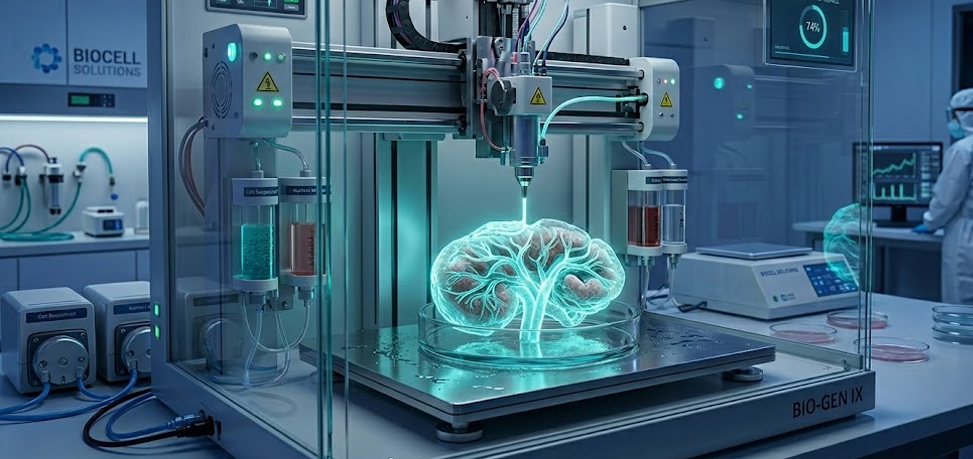
For decades, the idea of fabricating functioning human organs on demand was confined to the pages of science fiction. Today, it is rapidly becoming a clinical reality.
Organ transplantation has long been a race against time, plagued by severe donor shortages and the high risk of biological rejection. 3D bioprinting—the precise layer-by-layer deposition of living cells and biocompatible materials—is fundamentally reshaping the landscape of modern healthcare.
The Secret Ingredient: Bio-Ink
Unlike commercial 3D printers that melt plastics or metals, a bioprinter utilizes “bio-ink.” This highly specialized substance is a delicate blend of living cells suspended within a protective matrix.
[Patient Biopsy] -> Stem Cell Isolation -> Mix with Hydrogel (Bio-Ink) -> Layered 3D PrintingThe process relies on a few key steps to safely construct living tissue:
- Cell Harvesting: Scientists typically extract stem cells or primary cells directly from a patient via a simple biopsy.
- Hydrogel Scaffolding: The cells are blended with structural hydrogels (often made from natural proteins like collagen or gelatin). This acts as a temporary scaffold, keeping the cells hydrated, providing vital nutrients, and giving the tissue its shape.
- Cell Growth: Once printed, the cells naturally interact, multiply, and fuse together, transforming the artificial structure into a living, breathing biological tissue.
Accelerating Drug Discovery and Ending Animal Testing
While printing a fully functional heart for transplant is the long-term goal, bioprinting is making a massive impact right now in pharmaceutical laboratories.
Before a life-saving drug can reach pharmacy shelves, it must undergo years of rigorous safety testing. Historically, this meant relying on animal models or simple flat cell cultures in Petri dishes. Neither method perfectly mimics how a complex, three-dimensional human organ responds to a chemical compound.
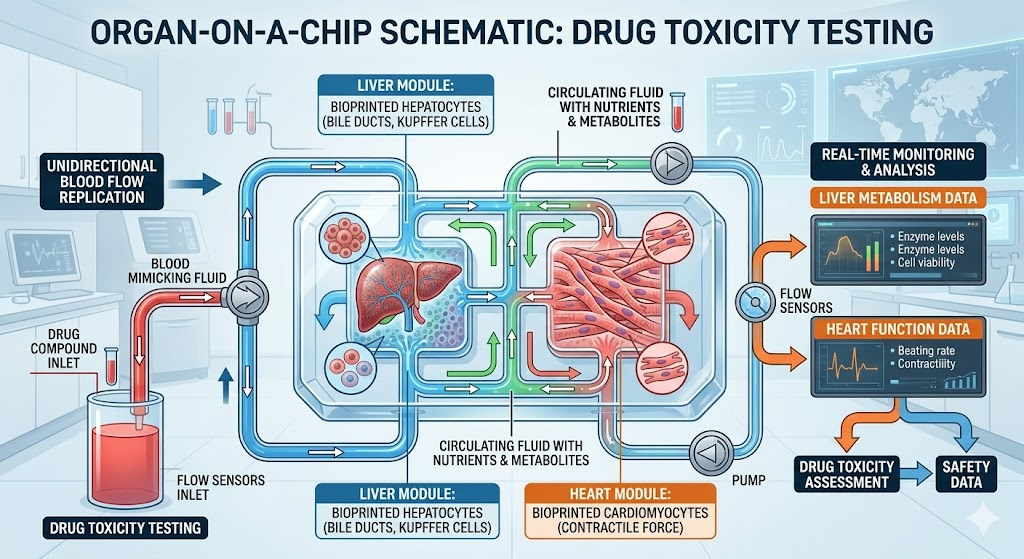
By bioprinting miniature human organ tissue arrays—often referred to as “organ-on-a-chip” models—researchers can test new compounds on actual human tissue from day one.
Why Bioprinted Tissue is Revolutionizing Drug Trials:
- Unmatched Accuracy: Scientists can observe precisely how a toxic drug interacts with a 3D human liver structure, catching dangerous side effects much earlier in the timeline.
- Personalized Medicine: Doctors can bioprint a miniature replica of a specific patient’s tumor tissue, testing multiple chemotherapy variants on the printed sample to see which one works best before treating the patient.
- Ethical Advancements: It drastically reduces the pharmaceutical industry’s reliance on animal testing.
The Path to Custom Transplantable Organs
The holy grail of 3D bioprinting is overcoming the global organ donor shortage. Thousands of people pass away each year waiting for a compatible match. Bioprinting aims to render waiting lists completely obsolete.
The ultimate advantage of this technology lies in biocompatibility. Because the printed organ is constructed using cells harvested directly from the patient’s own body, the patient’s immune system recognizes the new organ as “self.” This completely eliminates the need for lifelong immunosuppressant drugs, which traditionally leave transplant recipients highly vulnerable to infections.
The primary hurdle currently facing scientists is vascularization—the complex task of printing micro-microscopic networks of blood vessels (capillaries) inside the tissue to keep the inner cells supplied with oxygen. However, as bioprinting resolution pushes into the nanoscale, the dream of printing a completely custom, fully vascularized kidney or heart draws closer every single day.
The image is created by AI.



Leave a comment